Have you ever tried to join an important video call or drift off to sleep, only to be blasted by your neighbor's taste in loud music or the screech of traffic outside? You're not alone. In our modern, work-from-home world, unwanted noise is more than just annoying. It's a constant drag on our focus and well-being.
According to health guidelines, indoor noise levels should ideally stay below 45 decibels to prevent sleep disruption and elevated blood pressure.¹ Yet, many of us regularly live with noise levels above 70 decibels, which is like sitting next to a vacuum cleaner all day. Consistent exposure to this level of noise causes stress, cognitive fatigue, and long-term hearing damage.
But here's the good news. You don't need to tear down your drywall, hire an expensive contractor, or forfeit your security deposit to get some quiet.
Reclaiming your space comes down to understanding three simple principles: mass, decoupling, and absorption. By using smart, temporary fixes, you can block out the chaos and finally hear yourself think. Let's look at how you can do this without spending a fortune.
Identifying the Weak Links
Before you spend a single dollar, you need to find out how the noise is actually getting in. Think of sound waves like water. If air can leak through a space, sound will absolutely pour through it too.
A tiny gap can ruin your best efforts. Like, a mere eighth of an inch gap around a door frame can drop a high-quality door's ability to block sound by more than half.²
So, how do you spot these invisible leaks? Try the flashlight test. Turn off the lights in your room, have someone stand on the other side of the door with a flashlight, and look for light shining through the cracks. If light gets through, sound does too.
You should also pay attention to your walls and floors. If your walls are thin, they likely have a low Sound Transmission Class (STC) rating, which is the standard measure of how well a barrier blocks airborne noise.³ Standard apartment walls often have an STC of 33, meaning you can easily understand loud speech through them. Building codes require an STC of 50 for multi-family construction, but older buildings rarely meet this standard.
DIY Soundproofing Tips to Seal the Perimeter
Once you find the gaps, it's time to seal them up. This is the easiest and cheapest way to see immediate results, especially if you rent your home.⁴
Start with your doors, which are almost always the thinnest barrier in any room. They have the largest air gaps, making them the low-hanging fruit of soundproofing.
• Weatherstripping: Apply self-adhesive rubber weatherstripping tape along your door frames to create a tight, airtight seal when the door closes.
• Door sweeps: Slide a heavy-duty, U-shaped rubber door sweep onto the bottom of your door to block the massive gap above the floor.
• Acoustic curtains: Hang thick, multi-layered curtains over your windows. High-quality acoustic curtains can reduce mid-to-high frequency noises by up to nine decibels.
• Window inserts: If street traffic is driving you crazy, compression-fit acrylic window inserts are a great option. They press directly into your existing window frame without screws, reducing noise passing through single-pane windows by up to 70 percent.
These quick fixes require zero drilling, making them perfect for renters who need to take everything with them when they move.
Optimizing Your Interior by Softening Surfaces
Have you ever noticed how empty rooms sound incredibly echoey? That's because sound waves bounce off hard surfaces like hardwood floors, glass windows, and bare walls.
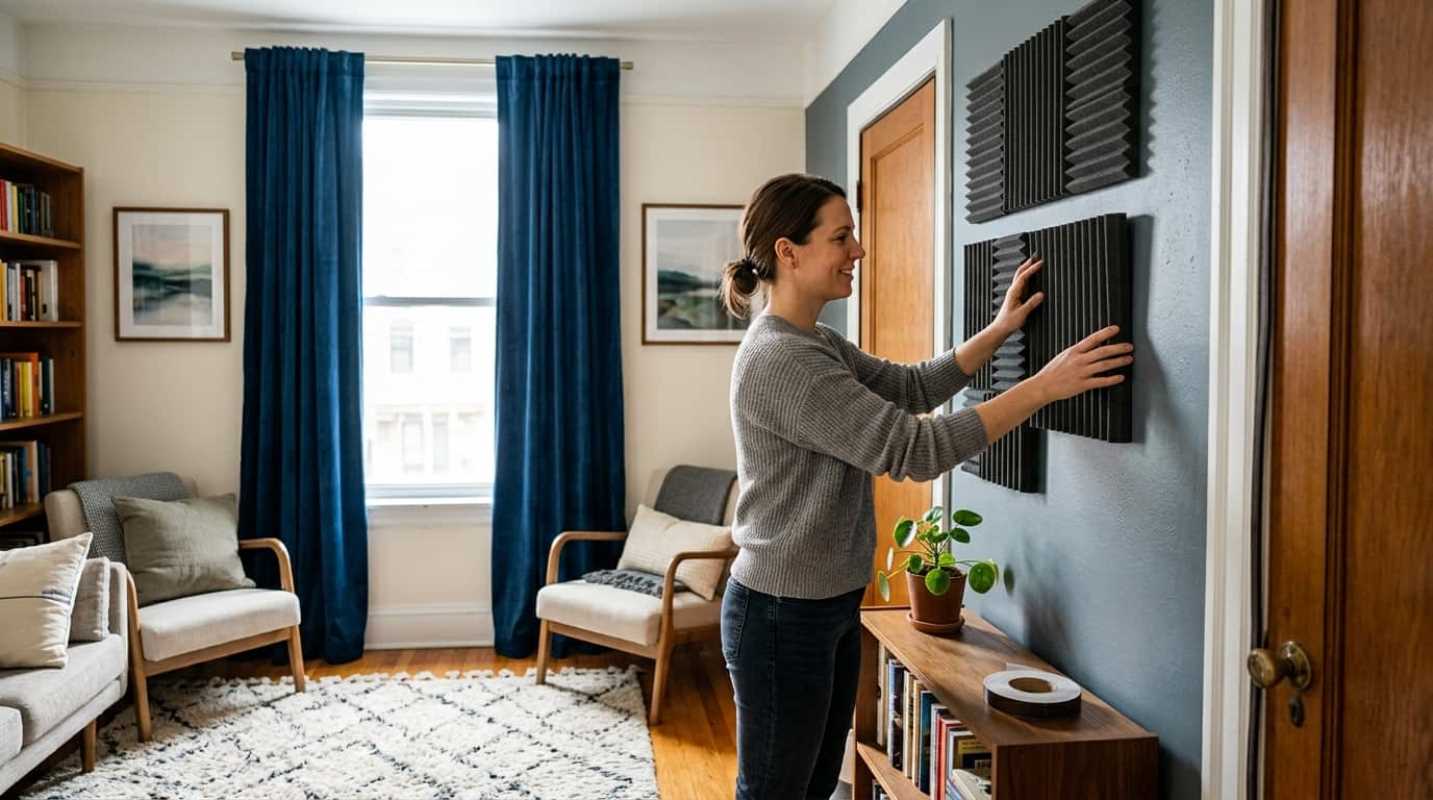
To stop this bouncing, you need materials with a high Noise Reduction Coefficient (NRC), which measures how much sound a material absorbs on a scale of 0.0 to 1.0. Acoustic foam has a high absorption rate, but remember that absorption is not the same as blocking. Foam panels will stop your voice from echoing, but they won't stop your neighbor's barking dog.
To quiet your room from the inside, you need to soften your surfaces. This reduces the overall noise level by stopping sound from building up and echoing.
• Thick rug pads: Lay down dense felt or memory foam pads under heavy area rugs to absorb footstep vibrations and ambient noise.
• Wall hangings: Use thick tapestries, canvas art, or fabric-wrapped acoustic panels to break up flat, reflective wall space.
• Strategic layout: Position your bed or desk away from shared walls, and place large, soft items like upholstered sofas in the path of incoming sound.
Advanced Non-Invasive Solutions
If sealing gaps and softening surfaces is not enough, you need to bring in the heavy hitters: mass and dampening. Sound struggles to pass through heavy, dense objects.
Let's talk about the difference between blocking sound and absorbing sound. This is where most people get tripped up. They buy cheap acoustic foam wedges online, stick them to the walls, and wonder why they can still hear their neighbor's television. Here's the secret: foam panels only stop your own voice from echoing. They do not stop outside noise from coming in.
If you want to block sound, you need mass. If you want to stop echoes, you need absorption. Egg cartons, by the way, do absolutely nothing for either. They have zero mass and do not create an airtight seal, so please save your cardboard.
One of the best ways to add mass to a shared wall without construction is by putting your library to work. A massive, fully stocked bookshelf acts as an excellent barrier because the heavy wood and varying depths of the books scatter and dampen sound waves.
You can also use Mass Loaded Vinyl (MLV), which is a dense, flexible material that blocks sound beautifully. Although builders usually hide it behind drywall, you can hang sheets of it using heavy-duty hook-and-loop strips, then cover it with a decorative hanging.
To deal with structure-borne noise, like footsteps from upstairs, you need to decouple your furniture. Place rubber vibration isolation pads under your desk legs, bedposts, or speakers to stop vibrations from traveling through the floorboards.
Finally, consider using a high-quality white noise machine. Although it does not physically block sound, it acts as a brilliant psychological buffer by raising the ambient noise floor, making sudden outside sounds much less jarring. If you want to start soundproofing your space today, here are some of the most reliable, non-invasive products to consider.
Your Sanctuary Awaits
You don't need to live in a state of constant auditory stress, and you certainly don't need to tear your home apart to find some peace.⁵ Soundproofing is a game of inches. Every gap you seal, every rug you lay down, and every heavy bookshelf you position adds up to a quieter, calmer environment.
Start with the easiest, most affordable wins first. Seal the gap under your door, hang some heavy curtains, and see how much of a difference it makes. You will likely find that a few simple, non-invasive changes are all it takes to turn your noisy room into a peaceful sanctuary.
Sources:
1. How to Soundproof an Apartment
https://www.apartmentlist.com/renter-life/how-to-soundproof-an-apartment
2. Sound Transmission Class (STC) Rating
https://www.acousticalsurfaces.com/blog/acoustics-education/sound-transmission-class-stc-rating/
3. Sound Isolation and STC
https://auralex.com/blog/sound-isolation-and-stc-sound-transmission-class/
4. How to Soundproof an Apartment
https://www.hellolanding.com/blog/how-to-soundproof-an-apartment/
5. The Sound Quality of Your Home
https://www.designwithfrank.com/blogs/building-guide/the-sound-quality-of-your-home-most-underrated-luxury