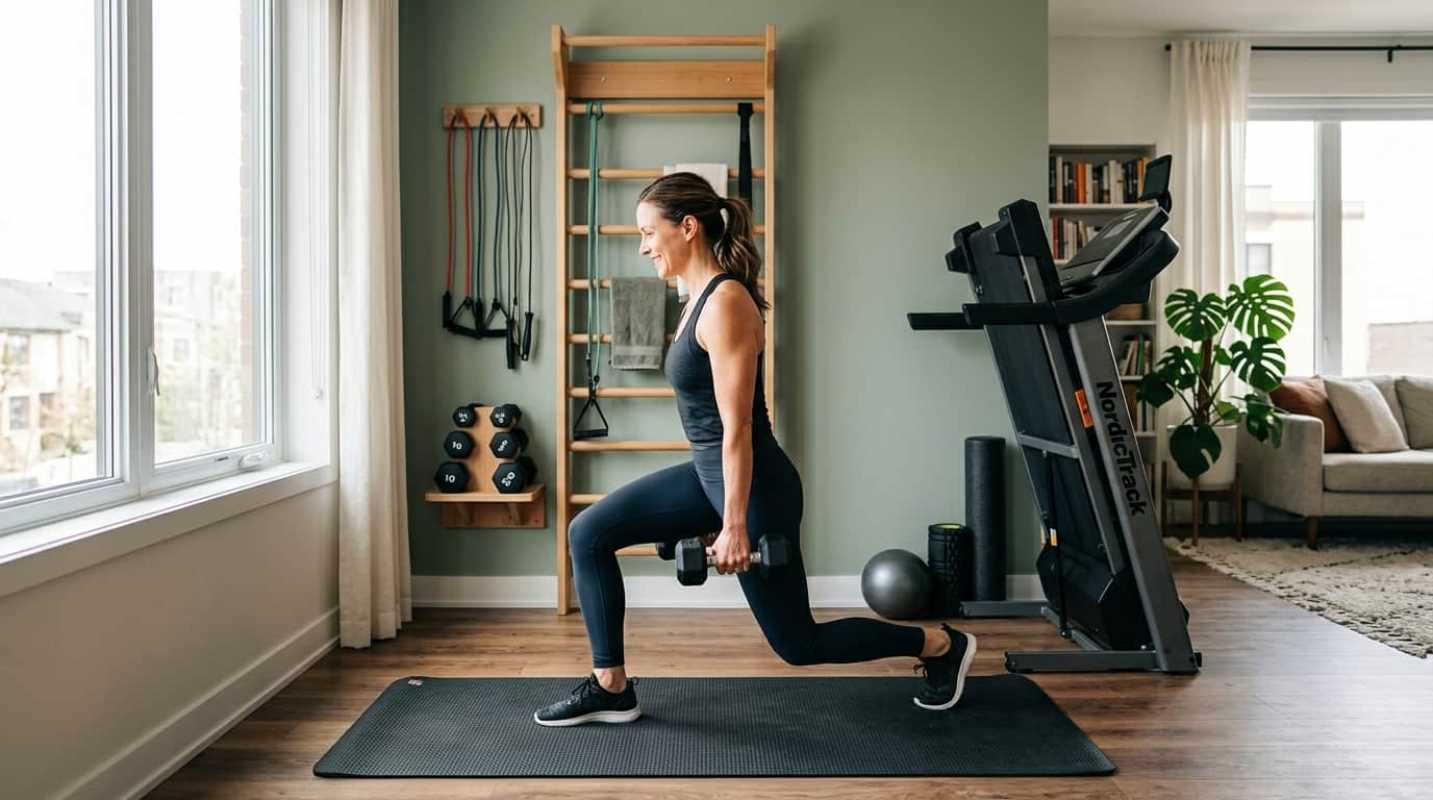
Do you really need a sprawling, mirrored basement to get in the best shape of your life? Absolutely not. The belief that you need a dedicated, commercial-grade room to build an effective home gym is a complete myth. In reality, some of the most consistent and intense workout routines happen in spaces no larger than a standard bedroom rug.
When you remove the friction of traveling to a commercial gym, your consistency skyrockets. There's a psychological power in making your workout gear immediately accessible. You don't have to pack a bag, fight for a parking spot, or wait in line for a squat rack. A survey by Garage Gym Experiment found that while saving money is a great perk, the primary driver for building a home gym is saving time.¹ Eliminating the daily commute turns a two-hour ordeal into a highly efficient forty-five-minute session.
Your fitness journey is built on consistency, not square footage. A compact setup that you actually use three times a week is infinitely better than an expensive, unused club membership. By shifting your focus from how much space you have to how smartly you use it, you can build a powerhouse training zone anywhere.
Assessing Your Footprint and Small Space Gym Ideas That Work
Before you buy a single dumbbell, you must map out your territory. The secret to success in tight quarters is understanding your working footprint. Coop from Garage Gym Reviews points out that many people measure their room and think a four-by-four-foot rack will fit, but they forget that you need an extra three feet on either side of a barbell to load plates, plus room in front to move. Always plan for the space you need during an exercise, not just where the equipment sits when it is idle.
Depending on your living situation, your space likely falls into one of three categories:
• The Micro Gym (Under 50 square feet): This is the ultimate low-profile setup for apartments, bedrooms, or even large closets. Your goal here is a zero permanent footprint. Look for gear that folds flat, slides under furniture, or hangs on a wall. You can use vertical wall storage like heavy-duty pegboards to hang resistance bands and jump ropes. Flat-folding benches and under-desk treadmills can slide completely out of sight when your workout ends.
• The Flex Space (50 to 100 square feet): This works perfectly for shared living rooms or home offices where the gym must disappear when guests arrive. A three-tier metal rolling cart can hold your adjustable dumbbells, yoga blocks, and bands, allowing you to roll your entire gym from a closet to the center of the room in seconds. You can also use a wooden storage ottoman to hide heavy kettlebells in plain sight. For flooring, use interlocking high-density rubber puzzle mats that can be assembled for a workout and stacked away afterward.
• The Compact Iron Paradise (100 to 200 square feet): If you have a single-car garage or a spare bedroom, you can build a highly permanent setup. The trick here is keeping the center floor clear by getting the most from your wall space. Fold-back wall racks fold flat against the wall when not in use, taking up less than five inches of depth. Wall-mounted cable columns also offer full-body functional training while eating up less than two feet of floor space.
Building Your Arsenal of Smart Budget Home Gym Equipment
Building a home gym does not have to break the bank. Although a fully custom, professional installation averages around $7,750, you can build a highly functional, space-saving budget setup for $300 to $1,000.² The global home fitness market has grown to over $12 billion, largely driven by smart, compact, and multi-functional designs.³ This means you have better options than ever before.
When shopping on a budget, remember the buy once, cry once rule. Exercise physiologist Chris Mohr, Ph.D., RD, notes that you should look for mostly metal construction. Cheap plastic adjustment dials on dumbbells or plastic pulleys on cable systems degrade quickly and pose serious safety risks. It's far better to buy one high-quality piece of gear than a cheap, flimsy all-in-one machine that will break within a year.
Bodyweight training and high-utility, low-footprint gear should form the cornerstone of your setup. Resistance bands, a single heavy kettlebell, and a pair of adjustable dumbbells can target every muscle group without cluttering your room.
Top Equipment Recommendations
Here are some of the best space-saving and budget-friendly products to consider for your home setup:
• Adjustable Dumbbells: The NordicTrack Select-a-Weight Adjustable Dumbbells adjust from 10 to 55 pounds, replacing up to fifteen pairs of traditional dumbbells. If you want an ultra-compact, traditional shape with a lightning-fast switching mechanism, the REP Fitness Quickdraw is another outstanding option.
• Foldable Weight Benches: The REP Fitness AB-3100 Adjustable Bench offers a 700-pound weight capacity and six adjustment angles for a very reasonable price. For those who need to slide their bench under a bed, the Hoist Fitness HF-4145 Folding Multi-Position Bench folds completely flat.
• Fold-Back Squat Racks: The Rogue R-3W Fold Back Wall Mount Rack uses a clever hinge-and-pin system to fold flat against your wall, taking up only five inches of depth when stored. If you want gas shocks that help you fold the rack straight up against the wall in seconds, look at the PRx Profile PRO.
• Compact Cardio: The UREVO Under Desk Treadmill is lightweight, flat, and easily slides under a couch. For serious conditioning, the Concept2 RowErg can be separated into two parts and stood upright, taking up a tiny two-by-three-foot footprint when stored.
• Budget Cable Systems: The Spud Inc. Super Econo Pulley System is a simple cable-and-pulley system that loops over any pull-up bar, allowing you to use your existing weight plates for lat pulldowns. For a more permanent option, the ER Kang Wall Mount Cable Station is a plate-loaded dual pulley system that mounts directly to the wall.
Creating the Vibe and Design Tips for Motivation
How your gym looks and feels has a massive impact on how often you use it. If your workout space feels dark, cluttered, and chaotic, you'll find every excuse to avoid it. You want to create an environment that actively pulls you in.
Start with lighting and mirrors. Hanging a large, inexpensive mirror on the wall does more than just help you check your squat form. It reflects light and makes a cramped room feel twice as large and far more professional. Position your setup near a window if possible, or use bright, daylight-mimicking LED bulbs to keep your energy high.
You also need a quick setup system. If it takes you fifteen minutes of moving furniture and untangling cords just to start your warm-up, you'll eventually quit. Keep your gear organized so you can transition from work mode to workout mode in under two minutes. Use dedicated bins, wall hooks, or rolling carts to keep everything in its place.
Finally, don't forget the tech. A simple wall-mounted tablet holder or a dedicated Bluetooth speaker can completely change the energy of your space. Play your favorite high-energy playlist or stream a follow-along workout class to keep your focus sharp.
Maintenance and Progression for Scaling Your Gym Over Time
Your home gym is a living project that should grow alongside your fitness level and your budget. You don't need to buy everything on day one. Start with a solid foundation, like a great pair of adjustable dumbbells and a flat bench, and expand from there as you hit your goals.
As you progress, you can keep your workouts fresh without adding physical bulk by rotating your accessories. Swap out your resistance bands for suspension trainers, or add a single kettlebell to introduce new movement patterns. This keeps your training novel and challenging without crowding your living space.
Safety must remain your top priority, especially in shared living spaces. The testing team at Breaking Muscle warns that the most common mistake beginners make is putting heavy weights directly on hardwood or thin carpet. Always use high-density rubber gym tiles to protect your subfloor and dampen the noise for your family or neighbors. Keep your equipment clean, check cable attachments for wear, and make sure your wall-mounted racks are securely anchored to wall studs. With a little planning, you can build a safe, highly efficient, and motivating fitness sanctuary in any corner of your home.
Sources:
1. Garage Gym Experiment Survey
https://garagegymexperiment.com/2026/01/16/notable-home-gym-survey-results-from-2025/
2. HomeAdvisor Cost Guide
https://www.homeadvisor.com/cost/additions-and-remodels/build-a-home-gym/
3. Fortune Business Insights
https://www.fortunebusinessinsights.com/home-fitness-equipment-market-105118