Have you ever walked into a house and immediately felt like something was off? Maybe the gorgeous modern kitchen felt cold and sterile, or the cozy bedroom felt noisy and drafty. Often, the culprit is right under your feet.
Your floor is the foundation of your home's entire design. It is the canvas for your furniture, the backdrop for your family memories, and the hardest-working surface in your house. Choosing the wrong material can be an incredibly expensive mistake.
Just look at how much we spend on our floors. The United States flooring market reached a massive $117.31 billion recently,¹ and home renovation surveys show that over a third of homeowners tackle a flooring project in any given twelve-month period.² Clearly, we care deeply about what we walk on. In fact, a major consumer survey revealed that 61% of American homeowners consider wood flooring a top priority when buying or designing a home.³
But how do you balance your personal style with the messy realities of daily life? Let's walk through how to choose the perfect flooring for every single room in your home.
High-Traffic Zones The Battle of Hardwood vs. Vinyl
Your hallways, entryways, and living areas are the front lines of your home. They face a daily onslaught of muddy shoes, pet claws, dropped keys, and heavy furniture. For these high-traffic zones, the debate usually comes down to two heavyweights: solid hardwood and luxury vinyl plank (LVP).
LVP has taken the design world by storm. Recent consumer data shows that LVP is the most visualized flooring material globally, capturing 30% of consumer interest.⁴ Why is it so popular?
• Waterproof performance: Unlike real wood, high-quality LVP is completely waterproof, making it a lifesaver for kitchens and mudrooms where spills are guaranteed.
• Scratch resistance: It stands up beautifully to large dogs and busy kids without showing wear.
• Comfort underfoot: It is softer and warmer to walk on than tile or stone.
On the other side of the ring is classic hardwood. Although LVP is highly practical, solid hardwood has a timeless appeal and unmatched resale value. You can sand and refinish solid hardwood multiple times over its lifetime, which can easily exceed one hundred years.
So how do you choose? If you have a busy household with pets and young children, LVP or high-quality laminate is often the smartest choice for main living areas. If you want to get the most from your home's long-term resale value and prefer natural materials, engineered or solid hardwood is the gold standard.
To make these spaces feel larger and more modern, look for wide planks. Planks that are seven to nine inches wide are the current standard because they reduce seam lines and open up your rooms. Also, skip the high-gloss finishes of the past. Low-sheen matte or satin finishes are much better at hiding dust, pet hair, and daily scratches.
Flooring Options by Room Bathrooms and Basements
Water is the ultimate enemy of flooring. In wet areas like bathrooms, mudrooms, and below-grade basements, your top priority must be moisture resistance and slip prevention.
For bathrooms and powder rooms, porcelain or ceramic tile remains the undisputed champion. Porcelain tile has an incredibly low water absorption rate (less than 0.5%), making it completely waterproof. It is also highly durable and easy to sanitize.
If you are designing a small bathroom, do not be afraid to get creative. Although main living areas benefit from warm neutrals (beige and brown tones make up a massive 92% of global flooring choices⁴), small spaces are perfect for bold patterns. Classic black-and-white checkerboard tiles or a beautiful herringbone layout can turn a simple bathroom floor into a stunning design statement.
Basements present a different set of challenges. Because they are below ground level, basements are prone to dampness, concrete subfloor moisture, and even minor flooding.
• Rigid core LVP: This is the absolute best choice for basements. It can be installed directly over concrete as a floating floor. If you ever experience a minor leak, you can actually unclick the planks, dry them out, and reinstall them.
• Temperature control: Basements are notoriously cold. LVP feels warmer underfoot than tile, but you can also install slip-resistant porcelain tile over radiant heating coils for ultimate comfort.
Creating Comfort Bedrooms and Cozy Spaces
Your bedroom is your personal sanctuary. It is the place where you want to feel warm, quiet, and completely relaxed. Because these spaces do not experience the heavy foot traffic of a hallway or kitchen, you can prioritize comfort and acoustics over sheer durability.
Wall-to-wall carpet is experiencing a major luxury resurgence. Cozy, high-texture cut-and-loop patterns are highly popular for bedrooms because they provide excellent thermal insulation and sound dampening. There is nothing quite like stepping onto a soft, warm surface first thing in the morning.
If you prefer a hard surface but still want warmth, consider these options
• Sustainable cork: Cork is a darling of the modern biophilic design movement. It is naturally quiet, hypoallergenic, and has a slight natural give that makes it incredibly comfortable to stand on.
• Hardwood with area rugs: This combination gives you the timeless beauty of real wood with the cozy warmth of a soft rug under your bed.
For allergy-sensitive homes, look for sustainable materials with low-VOC emissions to protect your indoor air quality. Materials like natural wool carpet and cork are excellent choices that are both eco-friendly and incredibly soft.
Budgeting and Longevity A Smart Approach
When shopping for flooring, it is easy to get hyper-focused on the price per square foot. But the sticker price is only one part of the equation. You also need to consider the cost of professional installation, underlayment, and the long-term lifespan of the material.
Porcelain tile and solid hardwood have higher upfront costs, but they can last for over half a century. On the other hand, budget-friendly materials like laminate or entry-level vinyl might need to be replaced in ten to fifteen years.
If you have pets, pay close attention to the technical specs. For LVP, look for a wear layer of 20 mil or higher. For laminate, check the AC rating (AC4 or AC5 is commercial-grade and highly scratch-resistant). As Hannah Nelson, a product manager at Mohawk, points out, practicality must meet your lifestyle needs, and ease of cleaning is a non-negotiable.⁵
Are you planning to install it yourself? Laminate and luxury vinyl planks with click-lock systems are highly DIY-friendly. Porcelain tile and solid hardwood, but almost always require professional installation to make sure they do not warp or crack prematurely.
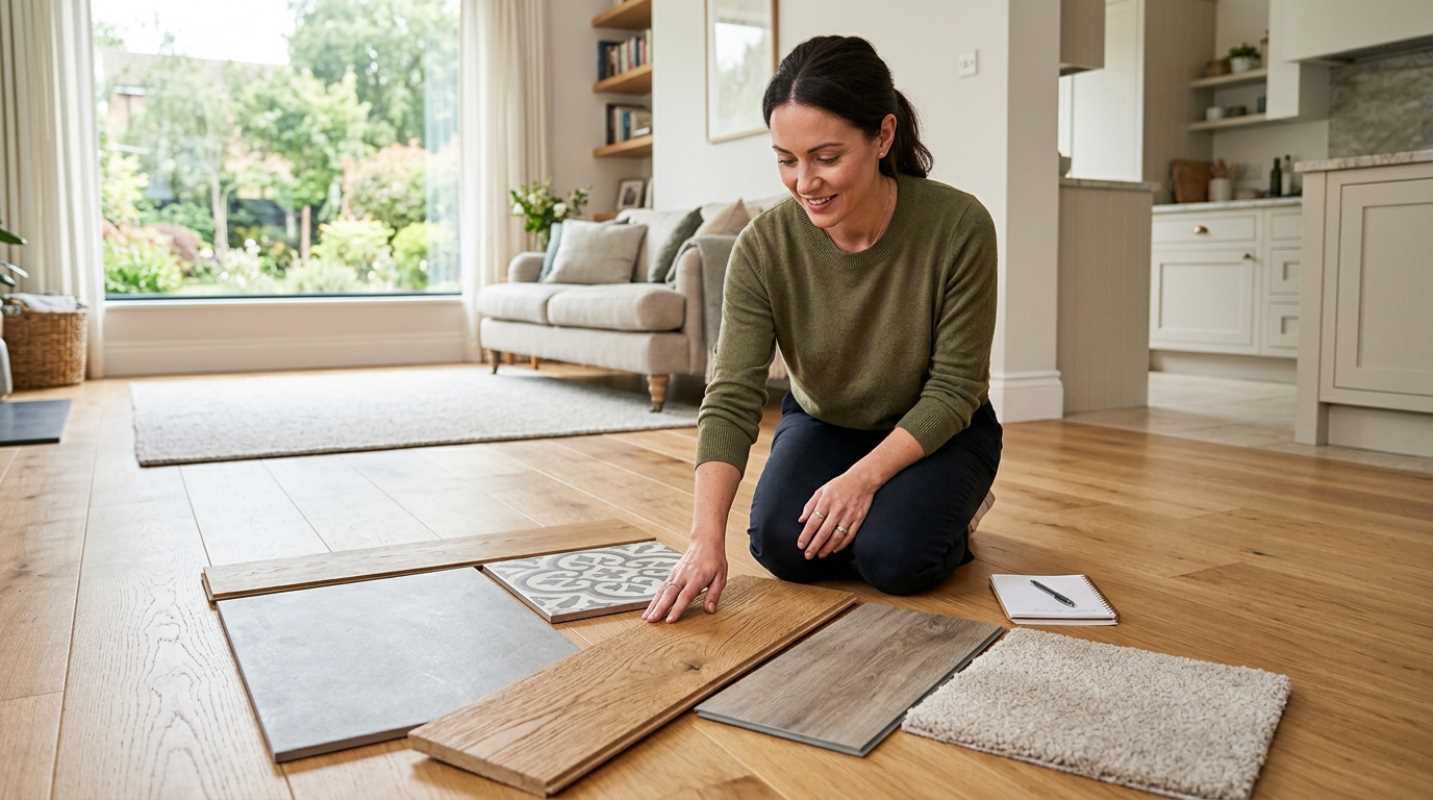
To help you compare your options, here is a quick breakdown of how the top five residential materials stack up
• Porcelain or ceramic tile: Highly durable and 100% waterproof. It is ideal for bathrooms and kitchens, though it can feel cold underfoot and requires professional installation.
• Luxury vinyl plank (LVP): Extremely durable, waterproof, and comfortable. This is the ultimate pet-friendly and basement-friendly option.
• Laminate (AC4 or AC5): Budget-friendly and highly scratch-resistant. It is perfect for living rooms and playrooms, but it can be damaged by standing water.
• Engineered hardwood: Offers the authentic look of real wood with better moisture resistance than solid wood. It is great for living and dining rooms.
• Solid hardwood: The ultimate long-term investment. It can be refinished multiple times and adds incredible resale value, but it is susceptible to water damage and scratches.
Stepping Into Your New Design
At the end of the day, the right flooring is the one that fits how you actually live. Do not buy a delicate, high-maintenance floor just because it looks beautiful in a magazine if you have three dogs and a busy family.
As trend expert Ashley Biscan notes, we are increasingly turning to natural materials and textures to breathe life into our homes.⁵ Embrace warm neutrals, focus on durability where it matters most, and do not be afraid to invest in quality. Your floors are the foundation of your daily life, make sure they are built to last.
Sources:
1. US Flooring Market Size & Growth
https://www.marketdataforecast.com/market-reports/us-flooring-market
2. Dumpsters.com Flooring Survey
https://www.dumpsters.com/blog/flooring-trends
3. Coverings Canada Consumer Trends
https://coveringscanada.ca/study-uncovers-key-consumer-trends-in-flooring-industry/
4. Roomvo 2025 Flooring Trends Report
https://www.floorcoveringweekly.com/main/specialreports/visualization-trends-46326
5. House Beautiful Flooring Trends
https://www.housebeautiful.com/design-inspiration/a64309897/flooring-trends-2025/