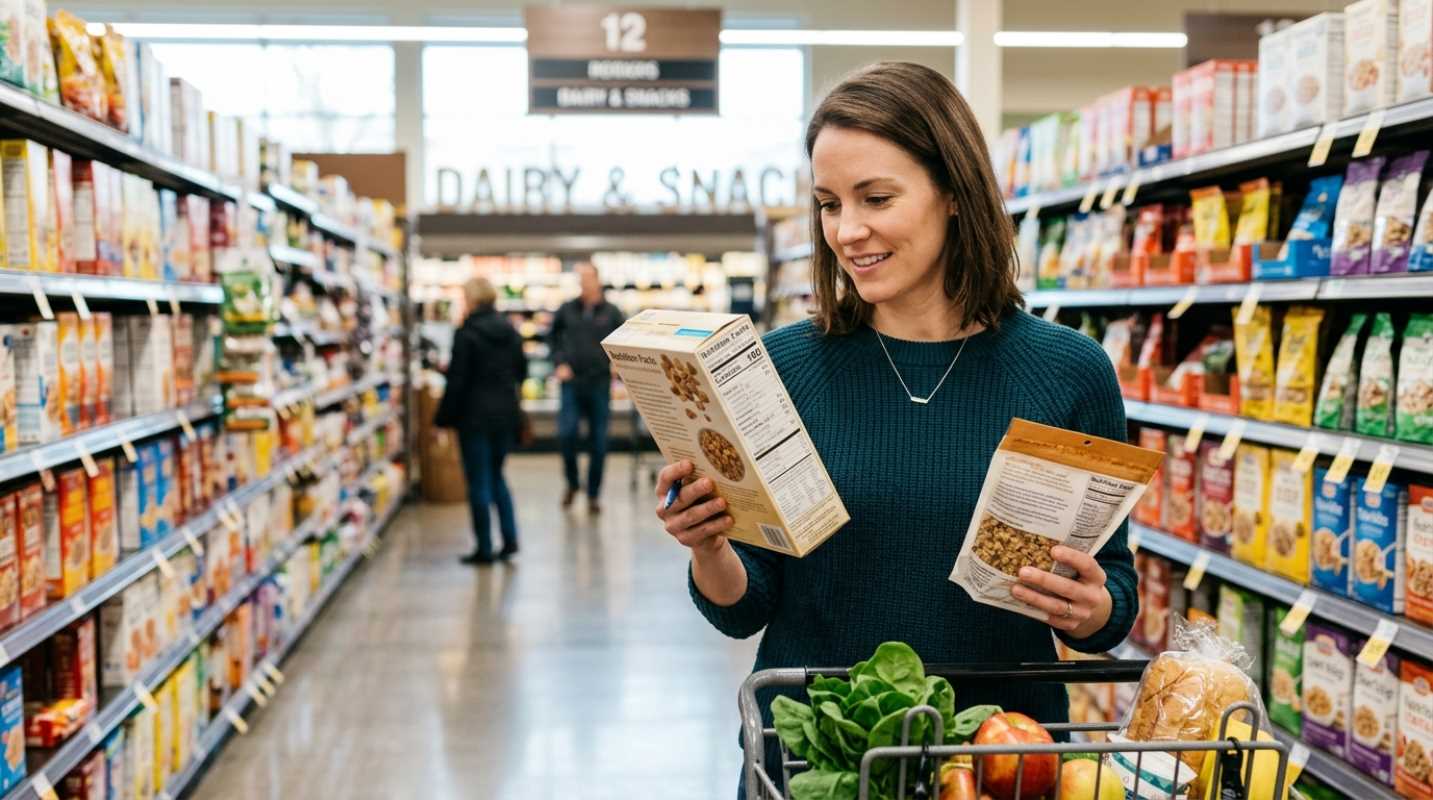
Have you ever stood in the grocery store aisle, staring at a box of cereal, feeling completely overwhelmed? You are not alone. Modern grocery shopping has become a stressful guessing game. Flashy graphics, bright colors, and bold claims scream at you from every single shelf, promising weight loss, heart health, or at least a guilt-free snack.
This guide is your ultimate nutrition label roadmap. We are stripping away the confusion and giving you the exact tools you need to read food packaging like a pro. No math degree or science background required. By the time you finish reading, you will feel confident, helped, and fully in control of what goes into your grocery cart.
The First Rule of Reading Food Labels Ignore the Marketing
Let's start with a hard truth. The front of a food package is not there to inform you. It is there to sell to you. Food marketers are absolute masters of psychology, using words like "natural," "organic," "multigrain," or "low-fat" to create a health halo around foods that are actually highly processed.
So what is the first rule of smart shopping? You need to train your eyes to ignore the front of the box completely. Instead, make it a habit to flip the package over the second you pick it up. The real story lives on the back, where the FDA-regulated facts cannot lie.
Those flashy slogans on the front are often clever distractions. A "low-fat" cookie, like, is almost always packed with massive amounts of extra sugar to make up for the lost flavor. By immediately turning the box over to read the ingredient list and the nutrition panel, you bypass the marketing traps and see the food for what it truly is.
Mastering the Macronutrient Breakdown
Once you flip that package, your eyes will likely land on the macronutrient breakdown. This is where you find the big three: protein, fats, and carbohydrates. Knowing how to quickly scan these will save you a lot of time.
To identify your macronutrients, look for their bold headers. Protein is the easiest to evaluate. You generally want to see a decent amount of protein in your meals and snacks because it helps keep you full and supports muscle health. Carbs and fats, but require a little more detective work.
Let's look at carbohydrates first. You will see "Total Carbohydrates" listed, with subcategories for dietary fiber, total sugars, and added sugars. Have you ever wondered about "net carbs"? Although the FDA does not officially define net carbs on the label, you can easily calculate them yourself. Simply subtract the dietary fiber from the total carbohydrates. Fiber passes through your body without raising your blood sugar, so calculating net carbs gives you a much truer picture of how that food will affect your energy levels.
Next, look at the fats. Not all fats are bad, and the label helps you distinguish the good from the bad. You want to look for healthy unsaturated fats, which are often left unlisted but make up the difference between the total fat and the listed saturated or trans fats. Your main goal is to keep saturated fats low and completely avoid trans fats.
If you are looking for simple ways to upgrade your pantry with nutrient-dense foods, here are some of our favorite kitchen staples.
Serving Sizes and Percent Daily Value The Math That Matters
Here is where many shoppers get tripped up. They look at a label, see "100 calories," and think they are making a great choice. But did you check the serving size?
The serving size is the most important line on the entire label. All the numbers you see below it, the calories, the fat, the sugar, apply only to that single serving. If a bag of chips lists the serving size as 15 chips, but the bag contains three servings, eating the whole bag means you have to triple all those numbers. Suddenly, that 150-calorie snack becomes a 450-calorie meal.
To make sense of the other numbers without doing complex math, use the % Daily Value (%DV). This percentage shows how much a nutrient in one serving contributes to a standard 2,000-calorie daily diet. To keep things simple, use the 5/20 rule
• 5% DV or less: This is considered low. You want to see this for things you want to limit, like saturated fat, sodium, and added sugars.
• 20% DV or more: This is considered high. Aim for this when looking for beneficial nutrients like dietary fiber, potassium, calcium, and vitamin D.
Fortunately, the FDA has been working to make this even easier for consumers. A newly proposed front-of-package "Nutrition Info Box" aims to place simplified ratings of "Low," "Med," or "High" for saturated fat, sodium, and added sugars right on the front of the box.¹ This quick warning system will help you spot high-sugar or high-sodium foods instantly without even turning the package around.
Also, the FDA officially updated the legal definition of the word "healthy."² Under the older rules from the 1990s, foods like avocados, nuts, and salmon could not be called healthy because of their fat content, while sugary, fat-free cereals could.³ The updated rule, which took effect in April 2025, requires foods labeled "healthy" to contain a meaningful amount of a recommended food group, like whole grains or lean protein, while staying under strict limits for added sugars, sodium, and saturated fat.⁴
Decoding the Ingredient List Quality Over Quantity
If the Nutrition Facts panel tells you what is in your food, the ingredient list tells you who is in your food. It is the ultimate truth-teller.
The first rule of ingredients is simple: order matters. Ingredients are listed in descending order by weight. This means the first three ingredients make up the vast majority of what you are eating. If sugar, refined white flour, or hydrogenated oil is in those top three spots, put the package back on the shelf.
Although a shorter list is generally a good sign of less processing, look at the quality too. A jar of marinara sauce with ten recognizable ingredients like tomatoes, garlic, and olive oil is infinitely better than a three-ingredient food packed with artificial preservatives.
You also need to watch out for the trans fat loophole. Under FDA rules, if a product contains less than 0.5 grams of trans fat per serving, manufacturers can round down and print "0g Trans Fat" on the label. But those fractions add up if you eat more than one serving. To protect yourself, scan the ingredient list for "partially hydrogenated oil." If you see those words, the food has trans fat, regardless of what the nutrition table claims.
Be on the lookout for hidden sugars, too. Manufacturers often use multiple types of sugar, listing them separately so they appear further down the ingredient list. Look out for
• The "-ose" words: Sucrose, fructose, dextrose, maltose, glucose.
• The syrups: High-fructose corn syrup, maple syrup, brown rice syrup, malt syrup.
• The natural traps: Agave nectar, honey, cane juice, coconut sugar, fruit juice concentrate.
To your liver, all of these sugars are processed the same way.
There is good news on the additive front, too. The FDA announced a phase-out of certain petroleum-based synthetic food dyes, such as Red No. 40 and Yellow No. 5, with a target completion date by the end of 2026.⁵ This push encourages manufacturers to transition to natural, plant-based colorings instead.
Your Path to Confident Shopping
Understanding the grocery store does not have to feel like walking through a minefield. By adopting a "flip-it-first" approach, you immediately take the power away from flashy marketing campaigns and put it back in your own hands.
You do not need to overhaul your entire pantry overnight. Start small. The next time you go shopping, pick just one or two items and examine their serving sizes, added sugars, and the top three ingredients. These small, conscious adjustments build the foundation for long-term health.
Ultimately, reading food labels is about helping yourself. Once you know how to read the clues, you can make decisions based on facts rather than marketing hype. You are the boss of your grocery cart, and now you have the tools to prove it.
Sources:
1. FDA Front-of-Package Nutrition Labeling
https://www.fda.gov/food/nutrition-food-labeling-and-important-foods/front-package-nutrition-labeling
2. FDA Finalizes Updated Healthy Nutrient Content Claim
https://www.fda.gov/food/hfp-constituent-updates/fda-finalizes-updated-healthy-nutrient-content-claim
3. Updated FDA Guidelines For 2025 Including Healthy Food Labeling
https://foodmedcenter.org/updated-fda-guidelines-for-2025-including-healthy-food-labeling-how-they-compare-to-the-2016-guidelines-and-what-it-could-mean-for-health-consumers-and-manufacturers/
4. FDA Use of Healthy Claim Food Labeling
https://www.fda.gov/food/nutrition-food-labeling-and-important-foods/use-healthy-claim-food-labeling
5. What's Changing on Food Labels in 2026
https://www.ingredicheck.app/blog/whats-changing-on-food-labels-in-2026-fdas-new-rules
*This article on Aminery is for informational and educational purposes only. Readers are encouraged to consult qualified professionals and verify details with official sources before making decisions. This content does not constitute professional advice.*